
Margin, markup, and the GST you are holding.
Three sums people get wrong in the same breath: a GST-inclusive price is not revenue, a margin is not a markup, and the price you need for a target margin is not cost plus that percentage. All three are below, with the formula written out and two worked examples.
Your margin
price includes 10% taxIt runs in your browser: nothing you type is sent anywhere, and the arithmetic is the file this page loads — the same one my tests check against figures worked by hand.
The formula, in full
ex-GST price  =  tax-inclusive ? price ÷ (1 + rate) : price
gross profit  =  ex-GST price − (unit cost + shipping, fees, packaging)
margin %      =  gross profit ÷ ex-GST price × 100
markup %      =  gross profit ÷ total cost × 100
price needed  =  total cost ÷ (1 − target margin)
Two things go wrong here more than anything else. A GST-inclusive price has a tax component of 1/11th, not 10% — $49 inclusive is $44.55 plus $4.45, so a margin worked on $49 is overstated. And margin is not markup: a 50% margin is a 100% markup, and a supplier quoting “50% markup” is offering you a 33% margin.
Two of them, computed rather than typed.
Both are produced by the same file the calculator above uses, so an example here cannot disagree with the tool beside it. Every figure is checked against hand-worked arithmetic in my test suite.
A $49 candle, GST-inclusive
price 49 · cost 18.5 · extraCosts 4.2 · taxRate 10 · taxInclusive true
A GST-inclusive price hides 1/11th of itself. The margin is on the ex-GST figure, not on the sticker.
A $1,515 vanity, ex-GST, sold to the trade
price 1515 · cost 1080 · extraCosts 95 · taxRate 10 · taxInclusive false
Freight on a bulky item is the cost people forget. Here it is $95 a unit and a fifth of the profit.
Straight answers.
Short answer (31 October 2026, Waqas Ahmad): margin is profit as a share of the ex-GST selling price; markup is profit as a share of cost. In Australia the GST you collect is 10% of the ex-GST price (Australian Taxation Office), so a $49 inc-GST sale is $44.55 of revenue, not $49, and the margin must be worked on $44.55. The calculator does that for you; the two questions below show the arithmetic.
Is margin the same as markup?
No, and the difference costs money. Margin is profit as a share of the price; markup is profit as a share of the cost. A 50% margin is a 100% markup. A supplier who says “we work on 50% markup” is describing a 33% margin. The calculator shows both, every time, so the sentence cannot be misread.
How does GST change it?
A GST-inclusive price is 11/10ths of the real revenue: $49 inclusive is $44.55 of revenue and $4.45 of tax you are holding for the ATO. Working a margin on the $49 overstates it by about two points on a typical product. Tell the calculator which kind of price you typed and it does the division.
What should I include in cost?
Everything that happens per unit: the unit price, inbound freight, packaging, payment fees, and outbound shipping if you are paying it. Not rent, not salaries, not software — those are fixed costs, and the break-even box is where they belong.
What margin should I aim at?
It depends on the category and nobody honest will give you one number. What the calculator can tell you is the price a target margin needs, which is the actionable version of the question: enter the cost, enter the margin you want, and it works backwards.
Does this handle VAT or sales tax?
Yes — set the rate. The arithmetic is the same for 20% UK VAT, 10% Australian GST or a US state sales tax; only the number changes. The one difference worth knowing: US sales tax is usually quoted exclusive, so leave the inclusive toggle off.
How do I calculate the profit margin on a Shopify product?
Start from the price the customer pays and take the GST out: in Australia divide by 1.1 (GST is 10%, Australian Taxation Office). Subtract everything that one sale cost you: the product, inbound freight, packaging, the payment fee and any shipping you absorbed. Divide what is left by the ex-GST price. A $49 candle is $44.55 ex GST; if it cost $20 all-in to sell, the margin is ($44.55 − $20) / $44.55 = 55.1%. The calculator above does the same arithmetic and shows the formula.
What is the difference between gross margin and net margin?
Gross margin takes out only what the product cost you. Net margin takes out everything the business spent to make the sale, including ads, apps, wages and rent, so it is always lower. This calculator gives you whichever one you feed it: enter only the product cost and you get gross margin; add freight, fees and packaging and you get the contribution margin per unit, which is the number to watch when you set a sale price.
A margin is only real if the order completes.
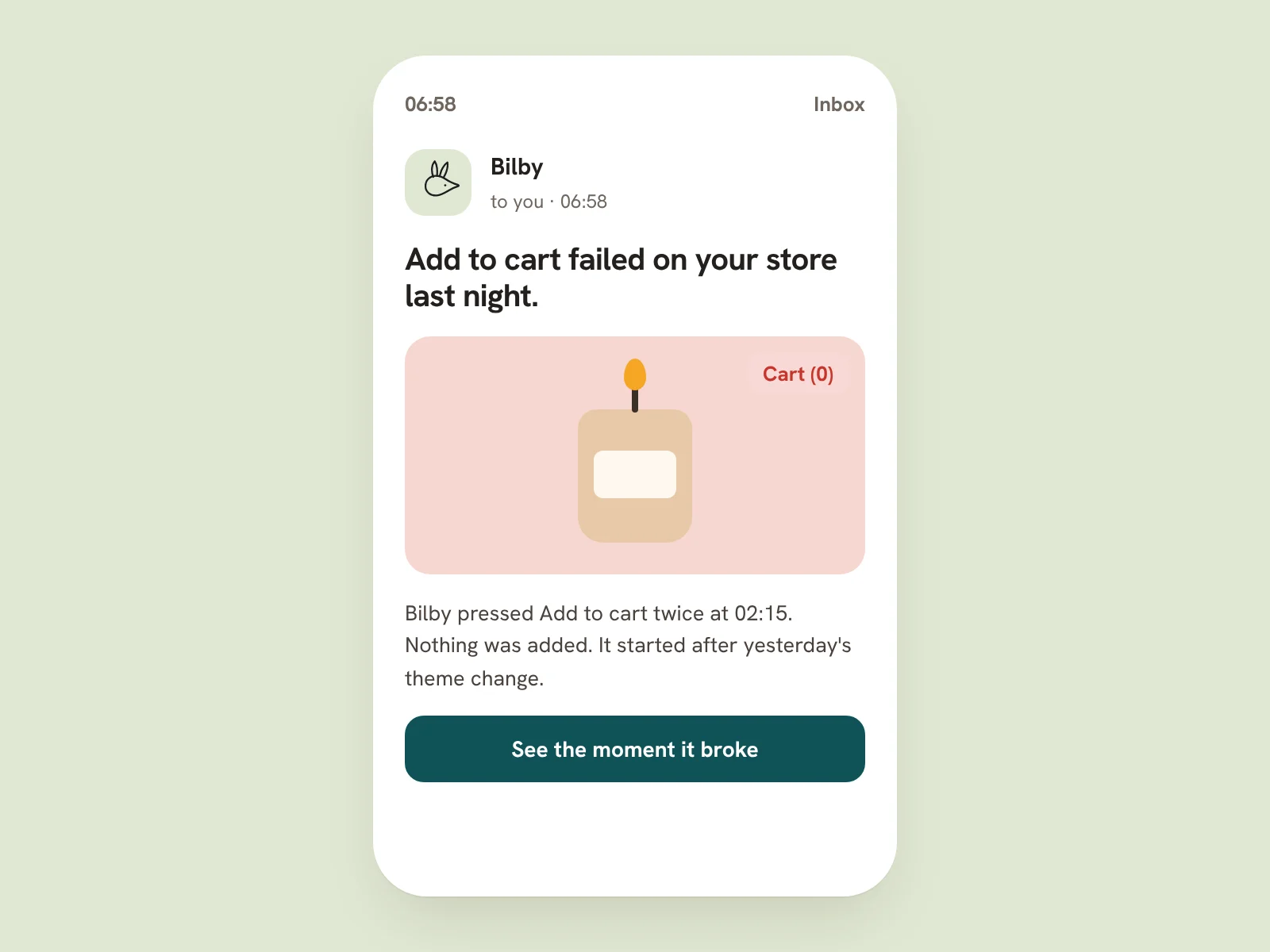
Bilby walks your buying path every night from six regions and tells you when a step breaks — which is the difference between a margin on paper and money in the account.
Where to go from here
What this looks like in the app

Start tonight.
Type your store. Bilby walks it now and shows you what it found. Free, no card.