
Is your Shopify tracking still working?
Scan your storefront and get a tracking health score out of 10 — free.
Enter a valid store domain — like yourstore.com.
Free · No email · The page is read in your browser
The scan reads your storefront. The audit reads your orders.
The full audit reconciles your last 30 days of real Shopify orders against the purchase events Meta and GA4 actually received. Exact gap, plain-English report, 48 hours. Prices include GST.
Navaal is operated by Waqas Ahmad, ABN 47 309 621 802, Sydney NSW, Australia. Replies from support@navaal.ai
Want the full 12-point self-audit checklist?
Everything a scan and three questions can't cover — checkout events, server-side conversions, consent mode, thank-you page tags — as a PDF checklist you can work through in an afternoon. One email. The checklist, nothing else.
This checks your tracking. Bilby checks the whole store.
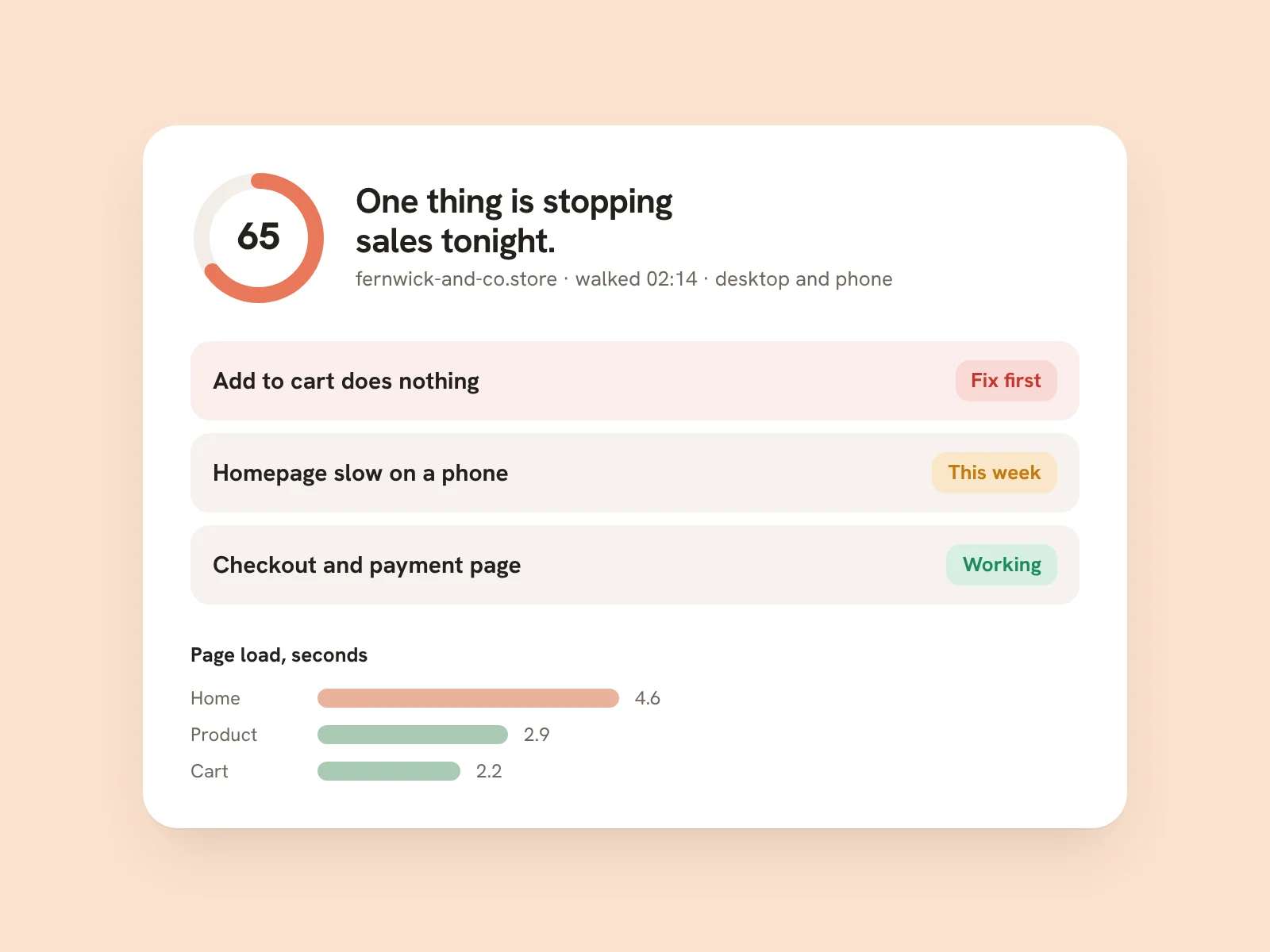
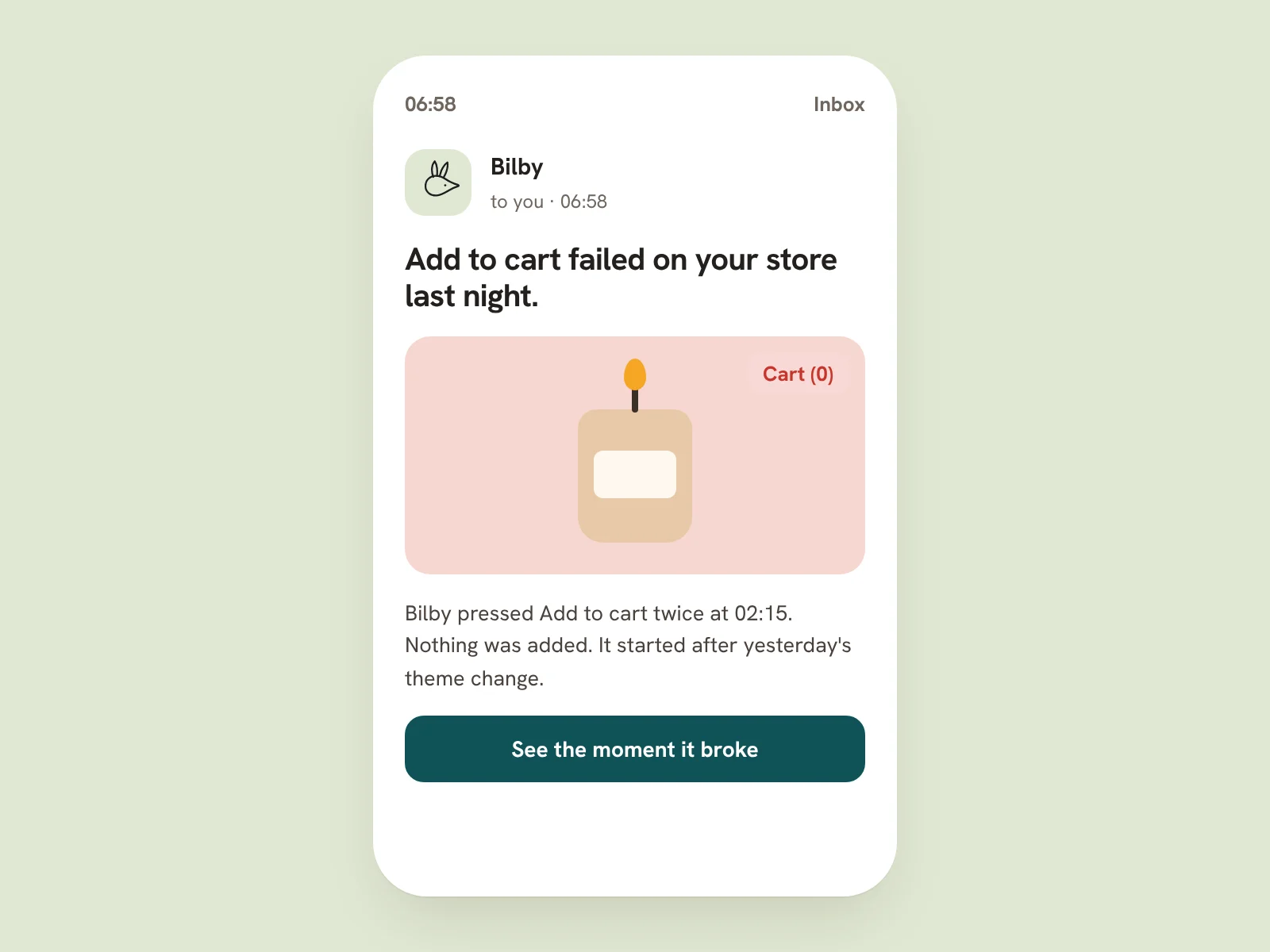
Tracking gaps are one way a store quietly loses sales — a broken add-to-cart or a checkout that failed after a theme update is another. Bilby is an AI customer that visits your store every night and emails you a screenshot the moment something breaks. One free scan, no signup.
A live product from Navaal · visits your store in a real browser
The upgrade that broke tracking without an error message.
Yes, you can check right now, for free: enter your store URL and I scan your public storefront for working conversion tracking — Meta pixel, GA4, Google Tag Manager, TikTok, and Shopify's modern Web Pixels layer — then score your setup out of 10. The reason this tool exists: the Shopify checkout upgrade in August 2026 permanently removed legacy checkout scripts from every non-Plus store. Orders kept processing, so most merchants saw no error — but on thousands of stores, Meta and Google quietly stopped receiving purchase data, reported ROAS fell, and ad budgets started optimising on incomplete numbers.
What a ten-second scan can honestly tell you.
No login, no access to your admin. I read your public storefront the way a browser does, and I'm upfront about the limits.
FETCH
I load your homepage
My scan service fetches your store's public homepage once — the same HTML any shopper's browser receives — and hands it back to your browser, which reads it. I do not store the address or the page. The service gives Cloudflare's rate limiter your IP address and the store's host as counter keys, kept for 60 seconds. Cloudflare, which runs the service, keeps its usual request counts.
DETECT
I find what's firing
Meta pixel, GA4, Google Tag Manager, TikTok, Pinterest, Snap, Klaviyo — plus Shopify's Web Pixels manager, the modern layer that survived the August 2026 checkout upgrade. Duplicate pixel IDs get flagged: double-counting inflates ROAS and corrupts ad optimisation.
THE LIMIT
Checkout stays invisible
No outside scan can see your checkout or verify purchase events actually arrive at Meta and GA4. Three self-check questions cover part of that gap — the full order-level audit closes it completely.
Straight answers.
What did the August 2026 Shopify checkout upgrade break?
On August 26, 2026, Shopify permanently removed checkout.liquid, Additional Scripts and legacy script tags from every non-Plus store. Any tracking code pasted into those boxes — Meta pixels, GA4 tags, Google Ads conversion snippets, affiliate scripts — simply stopped running. Orders still process normally, so there's no visible error. The most common symptom is ad platforms reporting fewer purchases than Shopify records.
Why did my ROAS drop after August 26, 2026?
If purchase tracking broke in the upgrade, Meta and Google now see fewer conversions than you actually get. Reported ROAS falls even though real sales haven't — and worse, the platforms optimise delivery on incomplete data, so performance genuinely degrades over time. A reported ROAS drop with steady Shopify revenue is the classic signature of broken tracking, not broken ads.
My pixels were installed by an app — do I still need this check?
Probably, yes. Apps built on Shopify's modern Web Pixels API survived the upgrade, but many older apps injected script tags into checkout — those were removed. Some stores also run an app pixel and an old pasted pixel side by side, which double-counts purchases. The scan shows what's actually firing on your storefront right now, independent of what any app's dashboard claims about itself.
What can a public scan see, and what can't it?
It sees your homepage the way a browser does: which tracking scripts load, which pixel IDs fire, whether Shopify's Web Pixels layer is present. It cannot see inside your checkout or thank-you page, and it cannot confirm purchase events arrive at Meta or GA4 — that takes matching your real orders against each platform's received events, which is exactly what the full audit does.
Is this really free, and what happens to my store URL?
Yes — free, instant, no email gate. Your URL is fetched once to read the public homepage, the analysis runs in your own browser, and nothing about your store is stored on my side. The optional email field exists only if you want the 12-point self-audit checklist sent to you.
Start tonight.
Type your store. Bilby walks it now and shows you what it found. Free, no card.