
A Shopify build of more than 10,000 products, not yet launched.
EBS Bathroom & Plumbing Supplies (askebs.com.au) belongs to my employer, who has agreed to it being shown here. The live store runs on WooCommerce today. I have built its Shopify version, which is finished and has not launched. This page is about that build: a data layer that knows which parts fit together, and trade quoting that produces a PDF instead of a cart.
Where this stands on 12 November 2026: the Shopify store on this page is a finished build awaiting launch. Nothing here describes the store at askebs.com.au, which runs on WooCommerce and which Bilby watches every night. The screenshots are of the unlaunched Shopify store.
What the size changes.
Why scale changes the job
At fifty products a person can hold the catalogue in their head and check it. At more than 10,000 nobody can, so the knowledge has to live in the data: which top fits which vanity, which basin a top can take, which finish matches which tap. The theme then renders what the data says and computes nothing itself — which is the only way a change to a matching rule can be made by someone who does not write Liquid.
The count is the product’s, not mine: the Navaal SEO app’s Home screen on this store read “10,000+” products in the catalogue on 10 November 2026. That screen is pictured on the app’s page.
Not launched yet, and what that means.
The store at askebs.com.au runs on WooCommerce, and that is the store customers buy from today. The Shopify store is finished and waits for its launch date, which is my employer’s to set.
So the move from WooCommerce to Shopify is prepared, not done. No customer has bought from the Shopify store, and this page makes no claim about traffic, search rankings or sales after a switch. When it launches, this page will say what happened.
What it looks like.
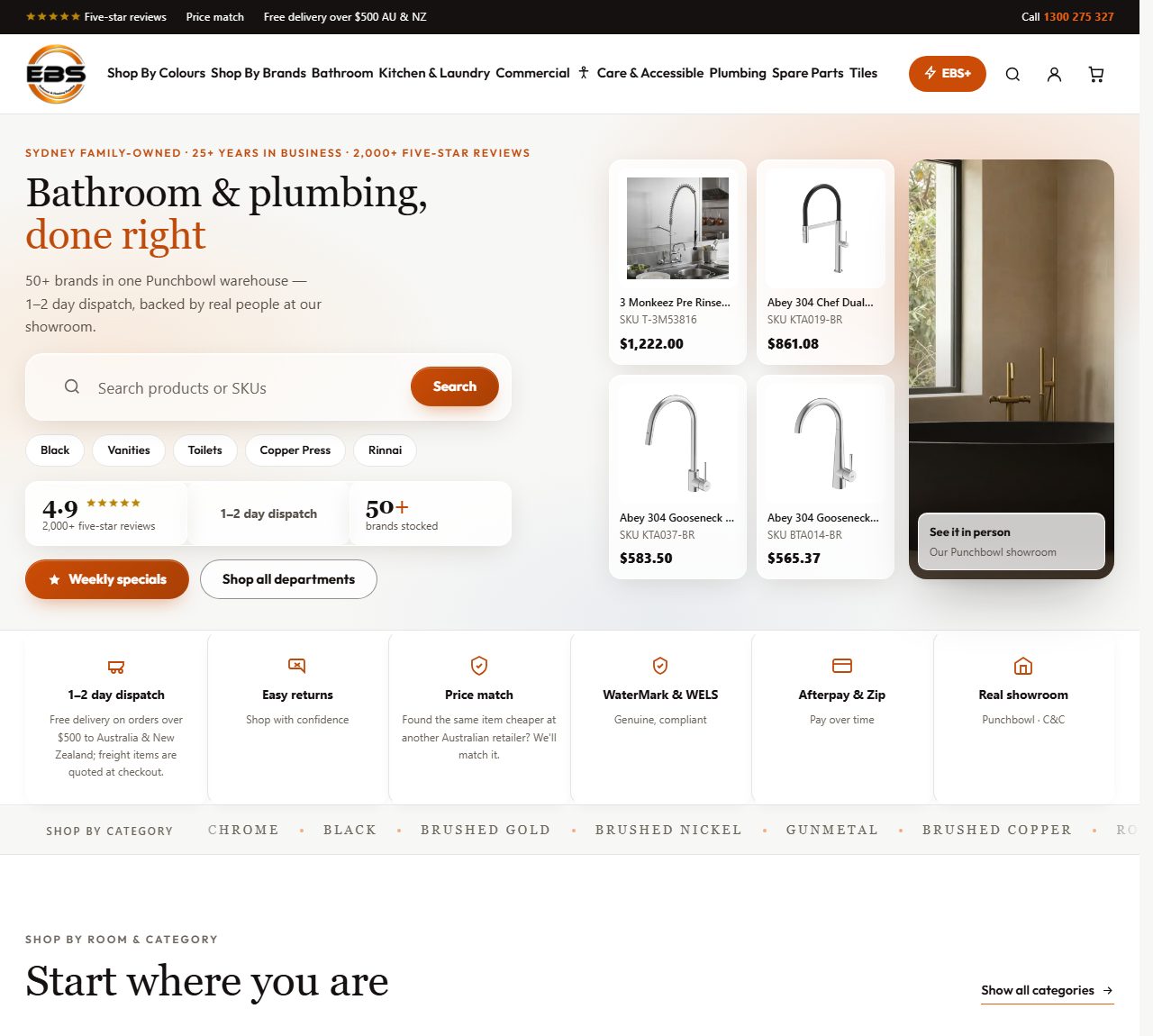
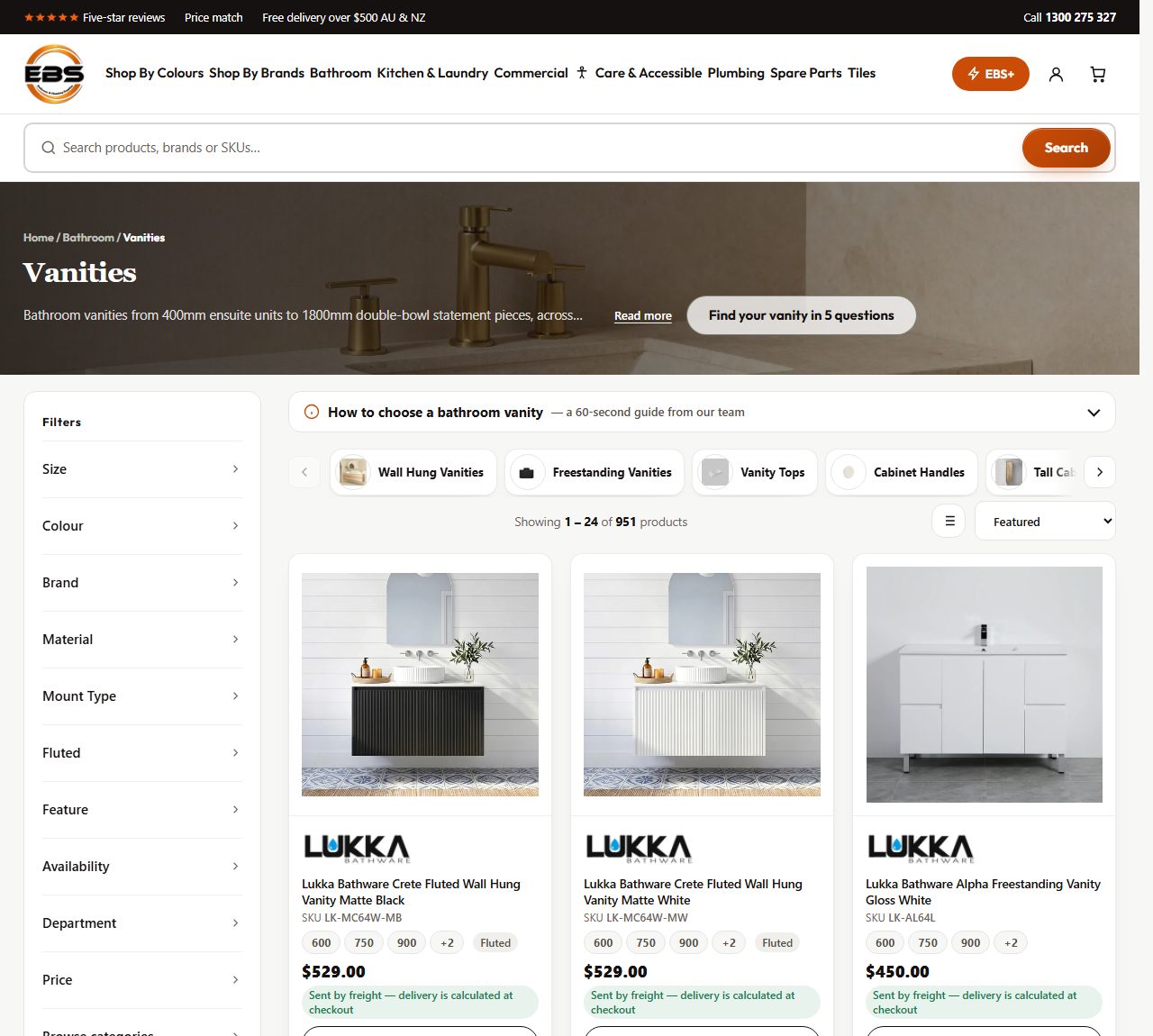
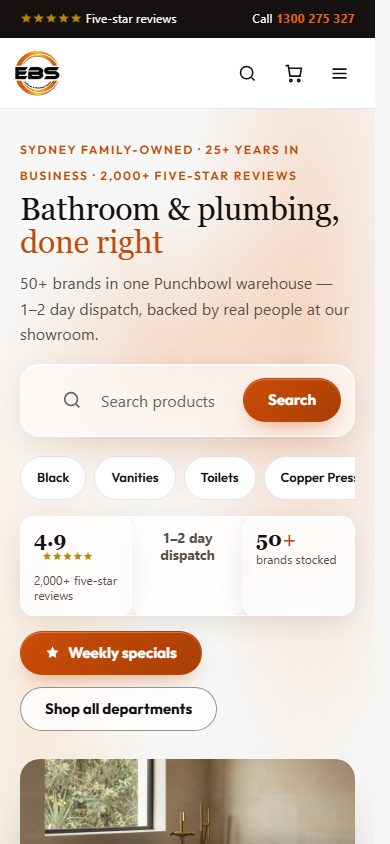
Screenshots of the unlaunched Shopify store, taken on 15 October 2026. Not mockups, and not a render.
A quote, not a cart.
A plumber specifying a bathroom does not want a checkout. They want a quote they can hand to their own client, with the right products and the right prices on it.
So the Shopify build makes a draft order from a selection and produces a PDF from it: the same catalogue, the same prices, on paper, without a retail checkout in the middle. It uses Shopify’s own draft-order mechanics rather than a parallel quoting system, which means a quote can become an order without anybody retyping it.
Straight answers.
Whose store is this?
My employer’s. EBS Bathroom & Plumbing Supplies belongs to my employer, who has agreed to it being shown here. I built its Shopify version. It is not an arm’s-length client reference, and you should weigh the page accordingly.
Is the store live?
The live store at askebs.com.au runs on WooCommerce today. The Shopify store on this page is a finished build that has not launched, and the launch date is my employer’s to announce. The screenshots are of that unlaunched Shopify store, taken on 15 October 2026.
Where does “more than 10,000 products” come from?
From the product, not from me: the Navaal SEO app’s Home screen on this store read “10,000+” products in the catalogue on 10 November 2026. The picture of that screen is on the app’s page. This page used to print more exact counts; they had no source a reader could open, so they have been taken down.
Why does a catalogue this size need different work?
Because the failures are different. At fifty products a person can check the catalogue. At more than ten thousand, nobody can, so the data has to carry the knowledge: which top fits which vanity, which finish matches which tap, what is in the box. That is a data problem with a rendering layer on top, and treating it as a design problem is how big catalogues end up with collections nobody maintains.
What are the trade quotes for?
A plumber specifying a bathroom wants a quote, not a cart. The Shopify build makes a draft order from a selection and produces a PDF the trade customer can take to their own client — the same products, the same prices, on paper, without a retail checkout in the middle of it.
Can you do this for my catalogue?
Yes. This one is not mine either: it is my employer’s. The work is the same for your catalogue; what the relationship changes is how much weight you should put on this page as a reference, which is why it says so up front.
A catalogue like this, on Shopify.
Shopify builds start at US$3,400 and a migration at US$3,100. Prices include GST. The cost guide prices your own build with the hours shown, and its form carries the estimate into the message.