
Write one product description, from facts you actually have.
Give it the product name and the real facts — the ones on the box, the spec sheet, the supplier email. It returns a description that opens with what the thing is and who it is for, a meta title inside 60 characters and a meta description inside 155. The facts it was not given, it lists instead of inventing: that box under the result is the point of the tool. Five a day, no sign-up, and it never sees your store.
One product here. A catalogue is a different job.
The Navaal SEO app writes and maintains answer-first content across a whole Shopify catalogue, from your real product data, with review before anything publishes. This page cannot do that and will not pretend to.
A worked example — a real product, a real run, 15 October 2026
This is the output of this endpoint on Poseidon Ultra Slim Wall Hung/Counter Basin 600mm Left Gloss White from the catalogue of EBS Bathroom & Plumbing Supplies (my employer’s store, not a Navaal store), on 15 October 2026, copied in unedited. I publish it rather than a hand-written sample because a sample I wrote myself would prove nothing about the tool.
Description
86 words · 4 bulletsThis wall hung or counter-mounted basin suits small ensuites and powder rooms. The Poseidon Ultra Slim combines compact dimensions with practical design in gloss white fine ceramic. - Left-hand bowl configuration leaves a flat ceramic shelf on the right side for toiletries or décor - Mounts either to the wall or sits above a counter, giving you installation flexibility - Compact 600 x 420 x 120 mm footprint fits tight spaces without sacrificing usability - 32mm waste outlet with overflow included; plug and waste sold separately
Meta title
58 / 60Poseidon Ultra Slim 600mm Wall Hung Basin Left Gloss White
Meta description
127 / 155Wall hung or counter basin, 600mm, left-hand bowl with right ceramic shelf. Compact design for small ensuites and powder rooms.
What it was not told
- tap hole configuration and number of tap holes
- plug and waste product availability or compatibility
- installation fixings or brackets included
What a generator can and cannot do for you, stated first. It can turn facts you already have into clean, consistent copy far faster than you can type it — that is real, and it is most of the work on a large catalogue. It cannot know your product. Every specification a model produces that you did not give it is a guess printed as a fact, and on a product page a wrong dimension or an invented warranty is a return, a chargeback or a consumer-law problem rather than a typo. So this tool is built the other way round: it is told to use only what you supply, and to list what it was missing. Read that list before you read the copy.
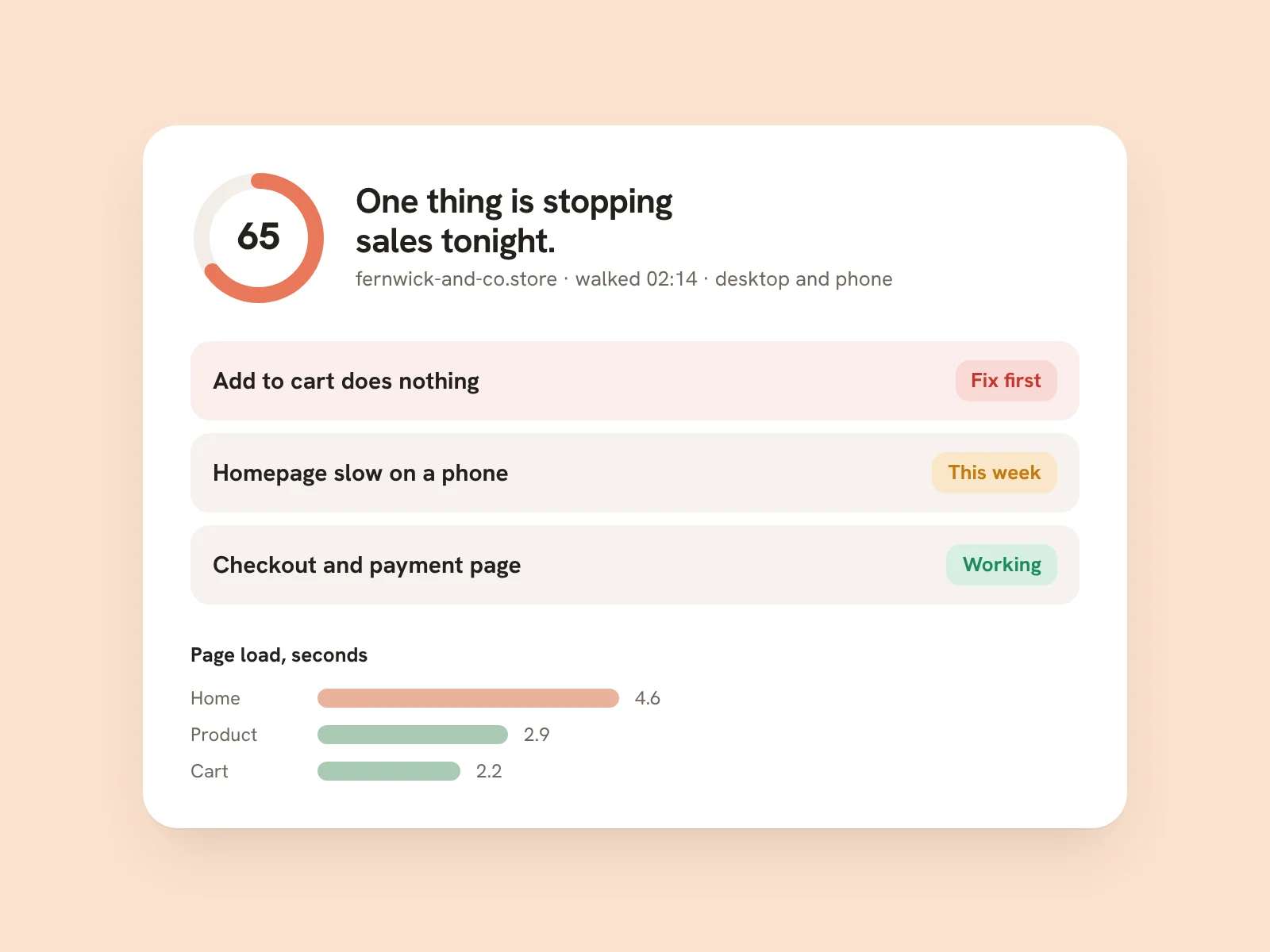
Three outputs and one list.
The shape is fixed because the shape is what makes copy usable: an opening sentence a shopper can act on, bullets that each carry one real fact, and two meta fields that fit the space a search result actually gives them.
Why “answer first” and not an opening flourish
A shopper who has landed on a product page from a search result is deciding one thing: is this the thing I meant. A sentence that answers that — what it is, who it is for, the one number that matters — does the job. An opener that warms up to the subject spends the only three seconds you were given. The same holds for the systems that now summarise pages: a page whose first sentence states the fact is the page that gets quoted, because there is something quotable in it.
So this tool is instructed to refuse a list of openers outright: no Introducing, no Elevate your, no rhetorical question, no exclamation marks, and no superlative it cannot support from your facts.
| Instead of | It writes | Why that matters |
|---|---|---|
| “Introducing our stunning new vanity, designed to elevate any bathroom.” | “A 900mm wall-hung vanity with fluted oak doors, supplied with a stone top and no tap hole.” | The second sentence can be checked, quoted and acted on. The first can only be believed. |
| “Premium materials and world-class craftsmanship.” | “Solid oak doors with soft-close hinges; 7-year warranty on the cabinet.” | Superlatives you cannot support are the part of product copy nobody reads and a regulator might. |
| Inventing “1,200mm, marble top, 10-year warranty” to fill the page. | Nothing — and “exact depth”, “top material” and “warranty period” in the list of what it was not told. | This is the failure that costs money. A missing fact is a question; an invented one is a dispute. |
The limits, in full
One product per run, five runs a day. Each run costs me money and the tool is free: the whole thing runs inside a US$2 monthly budget that stops it rather than letting it run up a bill, and when a limit is reached the page says which limit and what happens next. It never quietly returns something worse.
No store access. It reads the form and nothing else — no login, no API key of yours, no crawler, no connection to any platform. It cannot look up your real dimensions, which is exactly why it has to be told them.
Not a publishing tool. It gives you text to read, edit and paste. It writes nothing to your store, and it keeps no copy of your product text.
Still a language model. Check it against your own product data before you publish.
Regulated categories need a human. A model can add a phrase that was not in the facts supplied, and in a therapeutic category a phrase such as “soothe inflammation” is a claim rather than a description. For skincare, supplements, medical devices, food, children’s products or anything with a compliance regime, treat the output as a draft for someone who knows the rules, and delete any sentence you cannot point at a fact for.
Straight answers.
Will it make up specifications?
It is instructed not to, and it is told to list what it was missing instead — that list is the box under the result. It is still a language model: read what it wrote against your own product data before you publish it. Anything it could not have known (dimensions, materials, certifications, warranty, origin, price) should appear in the “what it was not told” box, not in the description.
Does it see my store?
No. It has no connection to any store, no login, no API key of yours and no crawler. It reads the words you type into the form and nothing else. If you want something that reads a whole catalogue, that is the app, and it asks your permission first.
Why only five a day?
Because each run costs me money and the tool is free. Five is enough to write a product properly or to judge whether the tool is any good, and the whole tool runs on a US$2 monthly budget that stops it rather than letting it quietly run up a bill. When the budget is spent the tool says so instead of degrading.
What happens to what I type?
It is sent to Anthropic's API to produce the answer and is not stored by me: there is no copy of your product text in my database, and the run is counted as a row with the date, your coarse IP and the token usage, which is how the cap works. I add no third-party script, cookie or tracker to this page.
Can it do my whole catalogue?
Not here — one product at a time, by design. A 10,000-product catalogue is a different job: it needs your real product data, variant-level handling, review before publishing and somewhere to put the result. That is what the Navaal SEO app does, and it is not free.
What are the character limits for?
Shopify's SEO preview truncates a page title around 70 characters and caps the description field at 320. Google renders roughly 60 characters of title and 155 of description on a desktop result. The counters here measure against the shorter pair, because that is what a shopper actually sees.
Where to go from here
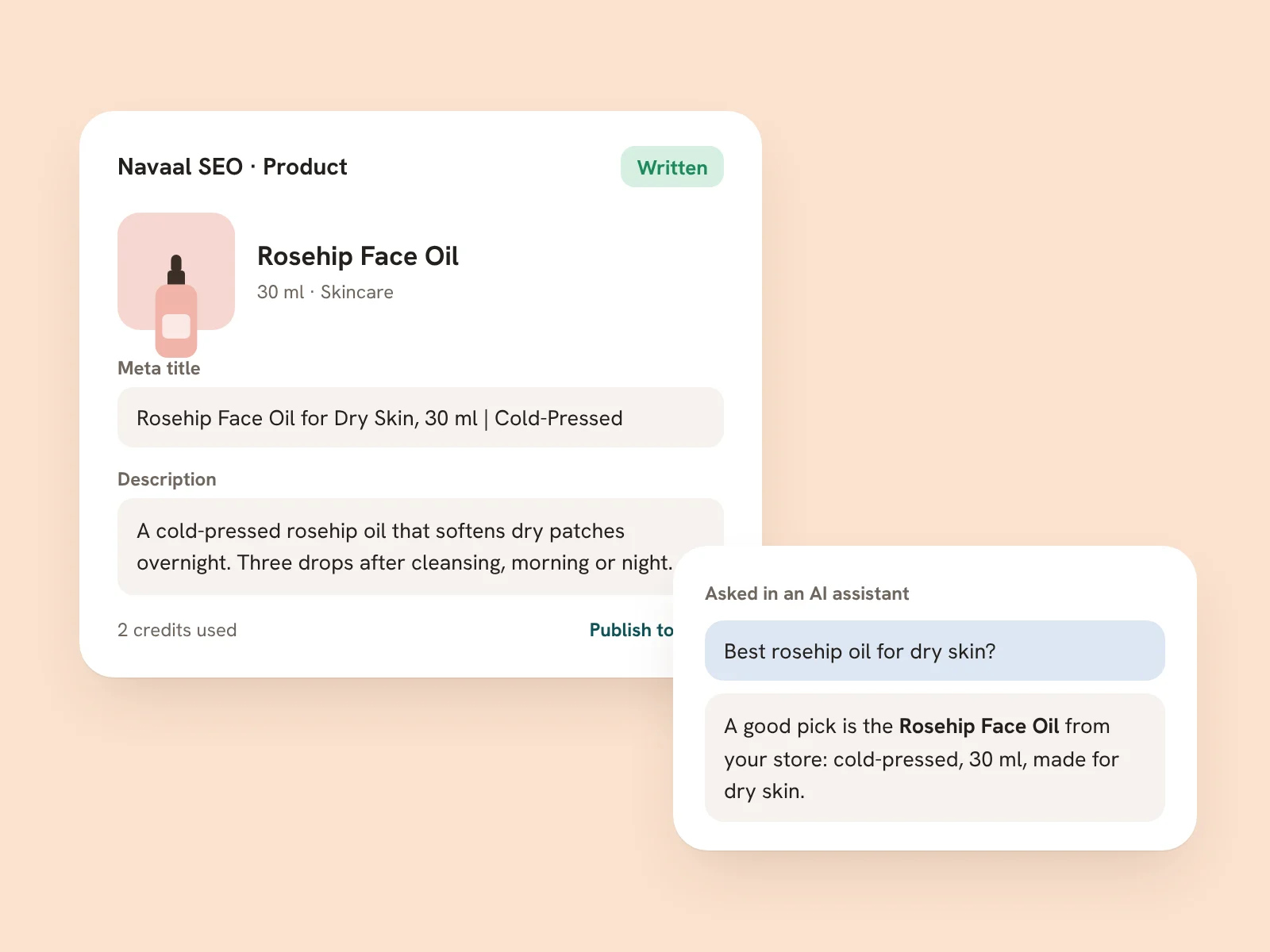
What this looks like in the app
Start tonight.
Type your store. Bilby walks it now and shows you what it found. Free, no card.